Welcome! We show how to use proper tools and a basic electronic tuner to tune a single note or the whole piano. Most other tuning sources tell you not to try, overwhelm you with technical detail, or really want to sell you a book. Our piano tuning web page is straightforward, online and completely free.
The tuning process is mechanically simple but difficult to master. Professional tuners spend a career perfecting their skills. Read this tutorial carefully, take your time, and don't expect immediate perfection. Thanks for visiting and good luck.
Part 1: Three Piano Tuning Tools
This process requires the following special tools. You will protect the instrument and have better results and with appropriate, quality tools. A set of good piano tuning tools will cost less than a single professional tuning.
1. Lever
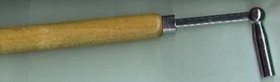 The most important tool is the piano tuning lever, hammer, wrench or key. A tuning lever is specifically designed to fit piano pins, which are square but also tapered. Its star-shaped socket allows for different handle positions for control and comfort. The most widely-used tip size is "#2."
To feel the subtle motions and maintain absolute control, the lever must have a firm handle and fit the pin securely. Inferior tools may fit poorly, ruining the feel, and perhaps getting stuck or causing damage. An inferior tool may become misshapen or break. 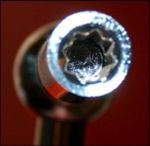 Simply put, in piano tools, the more expensive, the higher the quality. $20 levers are, in a word, useless. While descriptors vary, avoid "budget," "bargain," "economy," "beginner" or "gooseneck" levers. "German made" and "Grover-Trophy" are likewise empty descriptors. Medium-quality models are often labeled "student," "apprentice," "craftsman," or "professional"--but no matter the label, if the price is cheap, it is inferior.
Medium quality models like that pictured or better have interchangeable heads or even interchangeable tips in case you run into an odd pin or a cabinet configuration where a shorter or longer head is better, or just prefer the feel of a different size. Spend at least $50 on the lever alone. Professional tuning levers with daily-use durability and high-precision manufacture, are several hundred dollars minimum. Extendable handles makes it easier to use on a variety of piano cabinet styles, as well as increase the options for the comfort and preferences of the tuner.
Do you need a tip wrench? If you purchase a lever with an interchangeable tip, purchase a tip wrench to tighten the tip without damaging it. If you do not use a tip wrench, the tip is likely to unscrew while attempting to use it. (A tip wrench is not needed if the head and tip are a single, solid piece.)
Do not use a crescent or socket wrench. These pins are tapered; normal sockets are not. I tried it; it was a disaster. It slipped, tended to damage the squared corners of the pins, had too much wiggle for a good feel and was too short to control the turn. The larger handle of a proper lever is also more comfortable for long sessions. Do not risk damaging, bending or loosening pins. Buy a proper lever.
2. Electronic Chromatic Tuner
An electronic chromatic tuner, such as the Korg OT-120 is essential for the amateur. It will provide the reference for all the notes in the middle octave. It "hears" the tone you are nearest, and automatically adjusts the display to match without having to press more buttons. It will also play all the tones in the middle octave.
I first used a Korg CA-40. The CA-40 is adequate, but the best handheld tuner short of a dedicated professional electronic piano tuning device is the Korg OT-120 Wide 8 Octave Chromatic Orchestral Tuner. Its primary advantage is that it has a physical needle, rather than an LCD digital-emulated needle. A physical needle is smoothly responsive; LCD needles tend to jump as they move between the gaps in LCD display positions, making subtle distinctions difficult. Moreover, the OT-120 needle can be adjusted for sensitivity, labeled "slow" to "fast" on the dial. I keep mine on the slowest setting. This keeps the needle from flapping around from temporary harmonics. Other nice features are a more detailed display, a backlight, and the ability to select a pitch rather than rely on the device to auto-detect. The OT-120 also "hears" a wider range of octaves, and will display the octave number, though this is not particularly important for the act of tuning (see below for why). You can get by with a CA-40, but the OT-120 is more helpful.
Chromatic tuners come in many brands and styles. The very best electronic piano tuners, referred to as "Electronic Tuning Devices" or ETDs by pros, are $500 to $1800 or more. For the do-it-yourself method in this tutorial, any chromatic tuner can work. Be careful with "guitar tuners"; some will not work because they may recognize only certain notes or don't have the display we will need.
An an external contact mic is a very useful accessory for a chromatic tuner. Electronic tuners can be confused by extraneous sounds and vibrations in the room. The closer you can get to the source the better your results. For any Korg tuner the easy choice is the Korg CM-200 Clip On Contact Microphone. The CM-200 is a microphone on a wired clip with which you can get very close to the string you are working. Clip it to the metal framework near the octave you'll be working (not directly to the string.) I got by without it at first, but it is worth the few extra dollars. This model will work on any Korg chromatic tuner. The CM-200 has a standard quarter-inch (6.35 mm) TRS phone jack plug, and may be used on other devices that accept a microphone.
3. Mutes
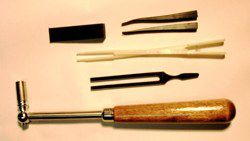
These rubber wedge mutes are only a dollar or two each. Assorted sizes come in handy. I use the ones with a wire handle most often. You'll want a variety of four to six rubber wedge mutes to get started.
You may also need a screwdriver to remove some of the cabinetry for the best access. You will also want a light source; you must see clearly what pin goes to what string. These interiors also accumulate a good bit of dust and cobwebs, particularly if they have not been regularly serviced; dust cloths and a vacuum can be helpful.
Where to Buy Tools
 Amazon and eBay sells tools(you were going to look there first anyway, right?) but beware: Amazon and eBay listings include cheap, poor-quality tuning tools as well as professional tools. I recommend a retailer that specializes in piano tuning equipment. They are small shops who know the products. Remember my advice: Pay for quality.
Pause for Reality Check
Now that we have our tools, lets take a deep breath before we start turning anything. We need to understand our limitations and goals, or, to put it another way, why a professional tuner tells you not to tune your own piano.
This is more than turning pins. A "good" tuning is two different things: accurate (in tune) and stable (stays in tune). The professional tuner develops these subtle skills through years of practice, and strive to perfect them their entire career.
This page does not replace the professional. The simplified approach here is for the curious owner, or those who want to touch up between professional visits, or perhaps performers who need an emergency adjustment. I have even heard from people who had an instrument so neglected that a piano tuner refused to work on it. This method might at least make it playable once more. But if you have something precious, a pro will do a better job. Even if you are serious and intend to learn more, the basic approach given here will be a good start to help you understand more in-depth sources.
These are large and complex instruments. It can be quite a task to get all the keys just right, and this gets worse the longer the instrument has been left untuned. A instrument that has been left untuned for a long time may not hold tune; it may need a "pitch-raise" (an extended regimen requiring several passes on the entire keyboard until everything will finally stay.) Beyond that, voicing and regulating the action may be required to restore the best tone. Some will require repairs, like misaligned hammers or loose pins. Such things are beyond this page, but we have books and other resources to recommend.
Consider the risks. Carelessness or inexperience can break strings, loosen or bend pins or cause other damage. Too many loose pins, for example, may render the instrument practically un-tunable and too expensive to repair.
Read this entire tutorial! I occasionally receive comments from professional piano tuners about this web site. Those remarks are welcome; I use them to improve the website. However, some seem to dismiss the site without reading it completely. On the other hand, I often receive positive comments from those who understand my goals. Please read the entire website carefully to be certain you understand the details, risks and limitations of this simplified procedure.
I taught myself on an old, student-quality instrument, not a priceless Steinway. I would not risk anything expensive or precious until I had plenty of practice. Still, I am happy with my results. I think other owners can do the same. With disclaimers out of the way, let's begin.
Part 2: Three Piano Tuning Steps
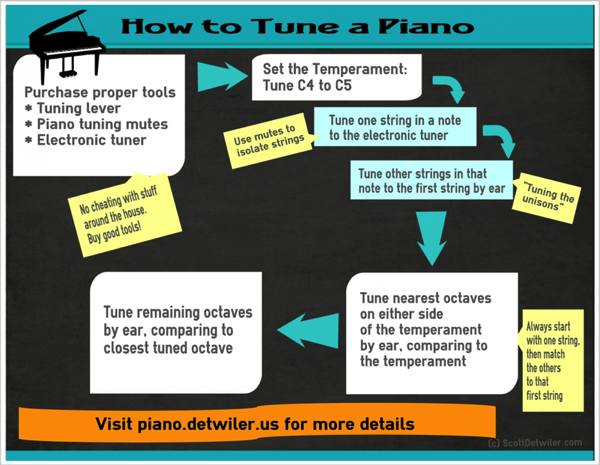
We have both a video and an info-graphic outlining the process. It is just an overview; be sure to keep reading this page for all the details.
Our Own YouTube Video
Our Infographic
Before you begin, clear the area of other humans. Turn off all other sources of sound, especially things that "hum." Lock the doors. Prop the lid wide open. You may need to remove some of the cabinet members; they are designed to be easily removed with no more than a screwdriver. Position your light source.
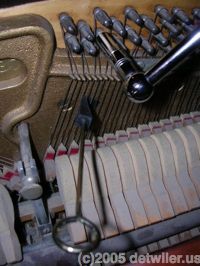
I has two strings per
key at this octave;
most instruments have three.
Step 1: Tune one string in middle octave
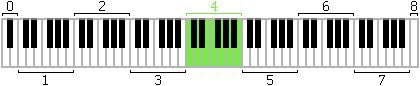
The middle octave is "middle C" also called C4, upward to C5. Each key in this region strikes three strings in most cases (two on some reduced spinets like mine.)
- Pick one string to work at a time; if three strings, start with the middle. Carefully find the pin that turns the string you want to tune. Place the lever so that the socket is fully seated on the pin.
- Place your foot on the sustain pedal to lift the dampers off the strings whenever placing or removing mutes. This will protect the felt of the dampers while you place mutes.
- Gently place the rubber wedge mutes to stop the vibration of the other strings in the set, but not so tight that the string is unnecessarily deformed.
- Turn the pin counter-clockwise to slightly loosen the string (flat the note). This assures that you are on the right pin, among other things.
- While repeatedly striking the key FIRMLY, turn the pin with the lever clockwise VERY SLIGHTLY until the Korg shows that it is in tune.
The Korg CA-40 or OT-120 automatically detect the note you are trying to reach. If the pitch is really off, the Korg may think you are on another note, so make sure you know what you are looking for. The OT-120 can be set to listen for a specific pitch. Alternatively, the CA-40 or the OT-120 can also play the tone for you to tune by ear. More about matching by ear in Step 2.
Important Details About Step 1:
- The lever socket must be securely placed on the pin. The pin will bend, mar or even strip corners if the lever socket is not seated completely. The handle should have no side to side movement when properly seated; the only direction of movement should be a radial turn.
- Proceed slowly. It's easy to get onto the wrong pin when starting. It can also take some time to get your ear accustomed to what you are listening for. If you are hasty you can stretch the string to the break point before you realize your mistake.
- Righty Tighty, Lefty Loosey! Turning the pin right/clockwise will tighten to raise the pitch. Turning it left/counter-clockwise will loosen to lower the pitch.
- Do not overwork the pin. Twist it gently, little by little, without bending it. Don't wiggle it side to side in any way. Move the pin as little as you can (you'll get better with practice.) Too much twisting and wiggling can loosen it; a loose pin will keep slipping out of tune. Rough technique may permanently loosen pins, requiring replacement by a technician. As a novice, it's better to stop with "pretty close" over "exactly right" in order to resist the temptation to overwork a pin. Perfection requires time.
- Listen carefully for a change in tone when you begin turning. You should hear a change in tone with even the smallest movements. If nothing changes, stop to make sure you are on the right pin.
- Loosen the tension (turn left) a little first before tightening (turning right). Better to relax the string with your first movement, than to over-tighten needlessly, especially if you happen to be on the wrong string! Over-tightening breaks strings, and is a common error for the inexperienced.
- Establish a pattern. Develop a consistent sequence for each note, e.g., middle string--right string--left string etc. You will eventually learn the pattern for what string goes to what note, you be less likely to choose the wrong pin, and you will not as easily loose track of what you have done. It does not have to be the order we give you; a pro piano tuner have his or her preferences, too
- About "Setting the Pin." Setting the pin means to move it in such a way that it does not easily slip back. To set, your final movements should be:
- a slight tightening/clockwise move to stretch the string just a hair above pitch
- followed by an even slighter loosening/counterclockwise to move into correct pitch.
- Strike the key firmly while turning the lever. The vibrations this creates equalize the tension along the string. A string firmly struck while turning will stay tuned longer. If play softly, the string may relax later when someone does play it hard, and it will slip out. If you like, you can begin with gentler hits; striking it hard all the time is exhausting and irritating to the ear. After you think you have a string tuned, finish with a very sharp "test blow" or two, then recheck the result before moving on.
- Tune to the "early" tone as you strike. As string vibration diminishes, the pitch will change slightly. Use the first, loudest sound made. Strike again if the volume begins to diminish before you finish. Hey, that rhymes.
- With an electronic tuner, particularly an inexpensive one with its low-resolution, jumpy LCD needle, you will find it nearly impossible to hit the exact frequency each time. I let the needle hover just a shade sharp when in doubt, as things generally (though not always) go flat over time rather than sharp. Note that I am not deliberately tuning sharp; rather I am avoiding erring flat due to the limitations of the display. (In some humid climates, notes may temporarily go sharp as the air moisture swells the soundboard, pulling the strings tighter. However, even here the change from humid to dry to humid will ultimately result in relaxed, flat strings.)
Step 2: Match remaining string(s)
After the first string is tuned, it's time to tune the other string or two in the set to the first; this is called "tuning the unisons."
- Move the mutes so that the first, tuned string and a second string are free, but the third, if present, is still dampened by a mute.
- Ignore the chromatic tuner; tune the unisons by ear.
- Put your wrench on the second string's pin. While repeatedly striking the key hard, turn the second pin until you can hear no more "beats"--that is, it sounds like one note, not two in disharmony.
- Repeat for the third string if necessary, with all rubber mutes removed.
Repeat Step 1 and Step 2 for each in note from C4 to C5. When you have completed this first octave, you have "set the temperament." In Step 3, you will use this first octave as your reference for the rest of the keys.
 If you are not sure what to listen for, here is an mp3 (104k file) I recorded of a unison being tuned. (Javascript Pop-up window.) In the recording, I start with an A4 that is in tune, then use the lever to loosen one of the strings out of tune, then bring it back into tune again. Disclaimer: In order to demonstrate in this mp3, I have turned the pin dramatically. Turn as little as possible to avoid loosening the pins.
Do not tune the unisons with the electronic tuner. It's all but impossible to get a match that way. Tuning unisons by ear is the quintessential skill here; no electronic device can replace it.
Step 3: Tune by comparing octaves.
When you have tuned all the strings in the middle octave, you have "set the temperament." You will now use this middle octave, not the electronic chromatic tuner, as the reference for the rest of the keys.
- Do not use the chromatic tuner.
- First, tune the octaves above and below the middle by ear, matching them to the middle octave, e.g, A4 to A5, B4 to B5, etc. Work one string in the note at a time (muting the others)--this time comparing it to the corresponding note in the middle octave rather than the chromatic tuner.
- Second, tune the other string(s) (that is, the unisons) within the note to the first as described above.
- Finally, work your way outward, octave by octave (e.g., A5 to A6, then A6 to A7, etc.)
Hit both a reference and the key being tuned at the same time with one hand while using the lever with the other. Since the hand only spreads one octave, this presents the risk that an error or a pin that slips can be carried on, so frequently compare to the temperament octave and already-tuned octaves as you go. As you get to the extreme high and low octaves, it becomes harder to hear precise differences between the reference and the target. If in doubt, err on the sharp side for upper octaves, and on the flat side for lower octaves for the best sound (see "Finer Points" below.)
Similar to unisons, the exact order of progression of key to key is up to you, but it's best to keep to a pattern to not miss anything. Furthermore, you may alternate between high and low octaves to keep tension on the soundboard equalized and your results stable.
Details About Step 3:
- Stretching Octaves: For the sound, one must "stretch octaves," which is to intentionally pull upper octaves progressively sharp and lower octaves progressively flat. Electronic equipment and software can help a professional piano tuner calculate precise stretch frequencies, but these are expensive, and even then he or she will often adjust it from the indicated value anyway. In our method, we are aligning the entire middle octave to an outside standard, which is not the best, but these notes are stretched very little if at all. Furthermore, by adjusting the remaining octaves by ear, we tend naturally to stretch the octaves because it "sounds right." This mimics the technique of someone who tunes by ear. Stretching is required because the physical differences among strings (length, construction) make them respond differently from the ideal; stretching in effect customizes the sound to the peculiarities of each instrument. For example, small spinets need more stretch than giant concert grands.
- Equal Temperament: The most popular modern model for the frequency for each note is called "equal temperament." Equal temperament is designed to give the overall best sound no matter in what key a song is played. The "ideal" piano would be tuned with mathematically calculated frequencies that have precise intervals between notes determined by the equal temperament model (though in practice the octaves must be stretched, see above.) Many different temperaments, or schemes, have been developed through the years. Some are experimental; others deliberately favor certain musical intervals. Interestingly, composers of the classical period composed for one of several temperaments popular in their time.
This chart demonstrates how far (in cents) from ideal equal temperament (straight, horizontal line at zero) the high and low octaves are "stretched" on a typical instrument (heavier, green line). Notice that the middle octave (4) is barely stretched, which is how we can "cheat" with an electronic device on the middle octave. Further note that how much an example of a real-life example (light, jaggy line) varies even from the expected stretch (heavier, green line). Even in the middle octave a professional may make small adjustments, which is why our method may be sufficient, but not ideal. A really good ear will be able to tell the difference.
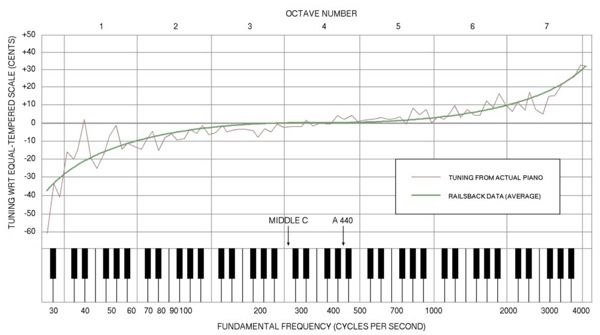 Chart: Brian Tung, GNU Free Documentation License
- Pitch Raise: When left untuned a very long time, the lack of proper tension on the soundboard by the many strings may physically change the shape of the board from the original design. It does not hold tune well because the misshapen soundboard warps in irregular ways: the notes you have already worked slip back out as you work notes elsewhere. If you find this is the case for you, the remedy is a pitch raise. This is a special way of tuning the entire instrument close, but not perfectly to pitch to stabilize tension on the soundboard, then fine-tune after it settles. Pitch raises are beyond the scope of this tutorial.
Common Questions about Piano Tuning
What if I just want to fix A2 or B6 or something? Tune the corresponding note (e.g. A4 or B4) in the middle octave to use as a reference. Note: if you have an electronic tuner that can show frequencies or play reference tones for octaves other than the middle octave, do not use it for anything but the middle octave. If you use the A2, for example, on an electronic tuner that is not specially designed for piano, you will not get a good result because of "inharmonicity."
Why not use the Korg (or an electric keyboard) for all the keys directly? Even if you get every note perfectly with a simple electronic tuner like a Korg, you will not get the best result. The different lengths and types of strings tend to alter their resonant characteristics from the ideal. This phenomenon is called "inharmonicity." The mathematically-calculated equal-temperament pitch actually sounds wrong for many keys, getting worse the further you are from the middle, and more so on smaller instruments with shorter strings. In an acoustic instrument that has been entirely tuned with a simple electronic tuner like the Korg, the top registers will sound flat, and the bottom registers sharp. Similarly, electric keyboards will not have stretch and so will not provide the correct reference, either. In practice, only A4 (A above middle C) is tuned to a outside standard pitch, 440 Hz; all the other keys are tuned relative to A4. In fact, a purely aural (by ear) tuner may just tune the "A" with a fork and do the rest by ear.In our simplified method, using a simple electronic tuner to set the temperament, then putting it aside to tune octaves by ear will get you closer to proper adjustment automatically because it will "sound right." This more closely approaches what a professional piano tuner who tunes by ear does. See "Stretching Octaves" below. If you desire an electronic tuner to do all the keys, then you will need a professional device or software, though a professional using these devices will make further adjustments.
How do you keep a piano from going out of tune? The primary strategy is to keep the environmental conditions as consistent as possible. Minimize changes in temperature and humidity; avoid placement near sunlight, windows, heating ducts, etc. After that, the best way to keep your piano in tune is to (surprise!) tune your piano. Once tuned, it is easier to keep it in shape with touch-ups and regularly-scheduled tunings. Don't wait until you can't stand the sound anymore. The longer strings are left untuned, the more the tension changes on the soundboard; this causes a cascade effect where more and more strings go out. The typical recommendation is to do a complete tuning twice a year, shortly after the heating and cooling seasons begin.
What is missing in this technique that a professional piano tuner would do? Listening is only part of the equation. The other part is moving the lever with precision so that the results are both accurate and stable. Both listening and lever-work require training, study and practice--perhaps a hundred attempts. In this tutorial we compensate for the listening somewhat by using the electronic tuner, but we cannot replace experience, especially experience handling the lever.
Another significant part of traditional aural methods that we skip is using fifths (e.g., A to D), fourths and other intervals. This requires counting "beats," that is the loud points in the vibrations that two dissonant strings make. (Remember that with unisons, that is, the strings of a single note, for example, you match them so the beats disappear entirely.)
In addition, a professional will know how to stretch the octaves for the best sound. A professional will be less likely to loosen pins or break strings. They may also make repairs, regulate (adjust the mechanical action of the hammers) and voice (service the wool pads on the hammers).
What Comes Next
More Tools
The lever, a chromatic tuner, and a few wedge mutes are all you need to get started, but several additional items that can make things easier or begin to take you to regulation and repair.
 Temperament strip in position. This particular instrument has only two strings per key in the temperament octave; the strip is muting one string on every note to leave the other strings tunable. Most units have three strings on each note in the temperament.
More Mutes of various sizes. One mute that many find essential, but we have not used in our tutorial for simplicity sake, is the temperament strip. The temperament strip is a long strip of wool felt with which you can mute many strings at once. It is used to mute all the outside strings of a section of notes so that only one string from each note can vibrate at a time. Push it between strings with a screw driver. That way you can efficiently work one string in each note without having to move rubber wedges every time you change notes. After one tunes all the single strings, tune the unisons by selectively pulling the temperament strip. Place it once, and complete the entire octave! This is actually a common professional approach, especially for setting the temperament (hence the name), though each person has preferences for when to use what mute. We start with rubber mutes in this tutorial because it is one less layer of complication for the beginner.

Treble Mute for muting the middle string in a triad; several types are available; Papp's tweezer-style pictured.
The long mute pictured here is a treble mute, which can be used to mute the middle string of a three-string "treble." It can also mute one or two strings quickly without placing wedges. Handy for spot checking.
If you would like to try repairs, you'll need additional tools, such as this basic regulation tool kit. Wire, key tops and other parts and accessories are also available. Repairs and restoration are beyond the scope of this website, but check our book recommendations.
For more questions and answers, see our FAQ.
Recommended Books and Links
Chuan C. Chang's book.
Chapter 1 teaches a method for learning to play; Chapter 2 is about tuning.
Precision Strobe
Lots the technical details. Not for the faint of heart!
Recommended Links
More links to content-rich websites with information for the do-it-yourself owner and player, gathered and reviewed by me.
Comment accorder un piano vous-même
Traduction Française de cette page
Do you find this tutorial useful, have a comment or a suggestion? Visit our Guestbook! Be sure to share us with your preferred social bookmarking agent.